
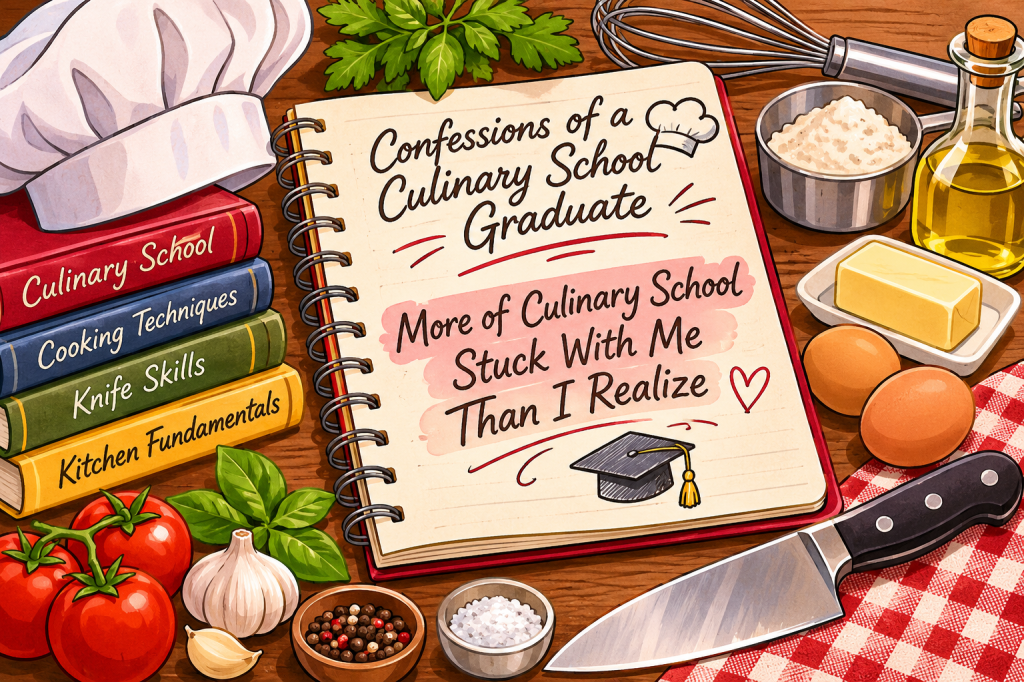
Welcome back, my friends, to week seven of my series, Confessions of a Culinary School Graduate!
This week’s confession is all about how just because I went to culinary school doesn’t mean I remember everything I learned or apply all of it to my cooking today. When I graduated, it felt like a lot of my knowledge had jumped right out the window. But as I cooked more and more, it became very apparent that wasn’t true.
This week’s confession is: More of Culinary School Stuck With Me Than I Realize.
I hope you enjoy reading this one just as much as I enjoyed writing it!
Kitchen Habits That Became Second Nature
There are a few things I learned in culinary school that have become second nature to me. One of those things is knife skills.
Believe it or not, there is a proper way to hold a knife, and that is by pinching the base of the blade with your thumb and index finger while wrapping the rest of your fingers around the handle. I also learned what different knives are used for, and even now, I use different knives for different things.
Something that many people don’t do when cooking is read through the entire ingredient list and all the directions before getting started. I learned to do this in college, but I didn’t always follow that advice. However, I have learned the hard way that reading through everything before cooking is important, especially if I’m making a difficult recipe.
Along with that, I also set out as many of my ingredients as possible before I start cooking so that everything is ready to go. The only ingredients I don’t take out right away are things like milk or heavy cream for obvious reasons.
Skills and Knowledge I Still Use
There are many skills and techniques I learned in culinary school that have stuck with me long after graduation, and I still use them today.
A few examples are:
- Clarified Butter
Clarified butter is made by slowly melting butter over low heat, allowing the milk solids to separate from the butterfat. Once those milk solids are removed, you’re left with clarified butter. It is useful in many different recipes and contains very little lactose, although it isn’t completely dairy-free. - Deglazing A Pan
To deglaze a pan means to add a liquid, such as broth, stock, wine (including cooking wine), or vinegar, to a hot pan and scrape up all those flavorful browned bits stuck to the bottom. This technique helps bring all that delicious flavor into your dish. - Blanching
Blanching is an extremely useful technique that involves briefly cooking food in boiling water. Afterward, you can transfer it directly into ice water to stop the cooking process. This second step is called “shocking,” and it helps prevent the food from continuing to cook.
There is a saying that is used in many places, not just the kitchen, that my chef told us over and over again during culinary school.
He always told us, “Do as I say, not as I do.”
I have even used that saying with other people in my life when teaching them how to cook!
Another thing he taught us that has stuck with me is that a dull knife is more dangerous than a sharp knife. This is because a sharp knife can slice through food much more easily, while a dull knife requires more pressure. If you apply too much pressure and the knife slips or goes somewhere it shouldn’t, it won’t end well!
When I Realized How Much I Remembered
I mentioned at the beginning of this post that once I graduated from culinary school, it felt like all my knowledge had jumped right out the window.
Well, over time, I started noticing that I was using techniques from school without even realizing it!
I also began noticing that there were things my chef taught us how to do in school but warned us not to try at home until we were confident enough to do them safely. And now, I do some of those things all the time!
One example is creating my own deep fryer using a deep pot and some oil.
However, if you are unsure how to use a deep fryer properly, you certainly don’t want to create one at home and start using it blindly! Working with hot oil can be extremely dangerous, so knowing how to handle it safely is very important.
Looking Back at Culinary School
When I look back at my time in culinary school, I realize there are some things my chef taught me that I agree with and others that I don’t.
One thing I don’t agree with is when he told us to follow recipes to the letter. I very much disagree with that because if you follow a recipe exactly every single time, how are you supposed to learn through trial and error?
On the flip side, there are many things he taught me that I do agree with. One small example is another saying my chef had:
“Practice doesn’t make perfect. Practice makes progress.”
That is something that has stuck with me ever since!
Many people have asked me what I would tell my younger self if I could go back in time. Well, I would go back to when I was in culinary school and tell myself to trust the skills that God has given me.
Don’t be afraid to take risks, and definitely don’t be afraid to change the recipe!
Until Next Week…
I want to thank you for tuning in to this week’s confession, and I hope you learned something from it!
Also, can you believe there is only ONE WEEK LEFT of this series?! I hope you have enjoyed reading these confessions just as much as I have enjoyed writing them!
Before I go, I want to leave you with something.
If you have graduated from culinary school, or if you enjoy cooking but don’t want to attend culinary school, let me tell you something:
You don’t have to stop learning!
Learning isn’t just about having someone tell you what to do. It’s also about trial and error, trying new things, making mistakes, and learning from them.
If you have any cooking techniques or skills that have stuck with you over the years, leave a comment and share them! I love hearing from you guys!
Also, since there is only one week left of this series, I want to hear your suggestions! Should I do another series? And if so, what should it be about? I would absolutely love to do another one!
Until Next Time…
Stay Saucy
Hailey 🍝

Leave a Reply