
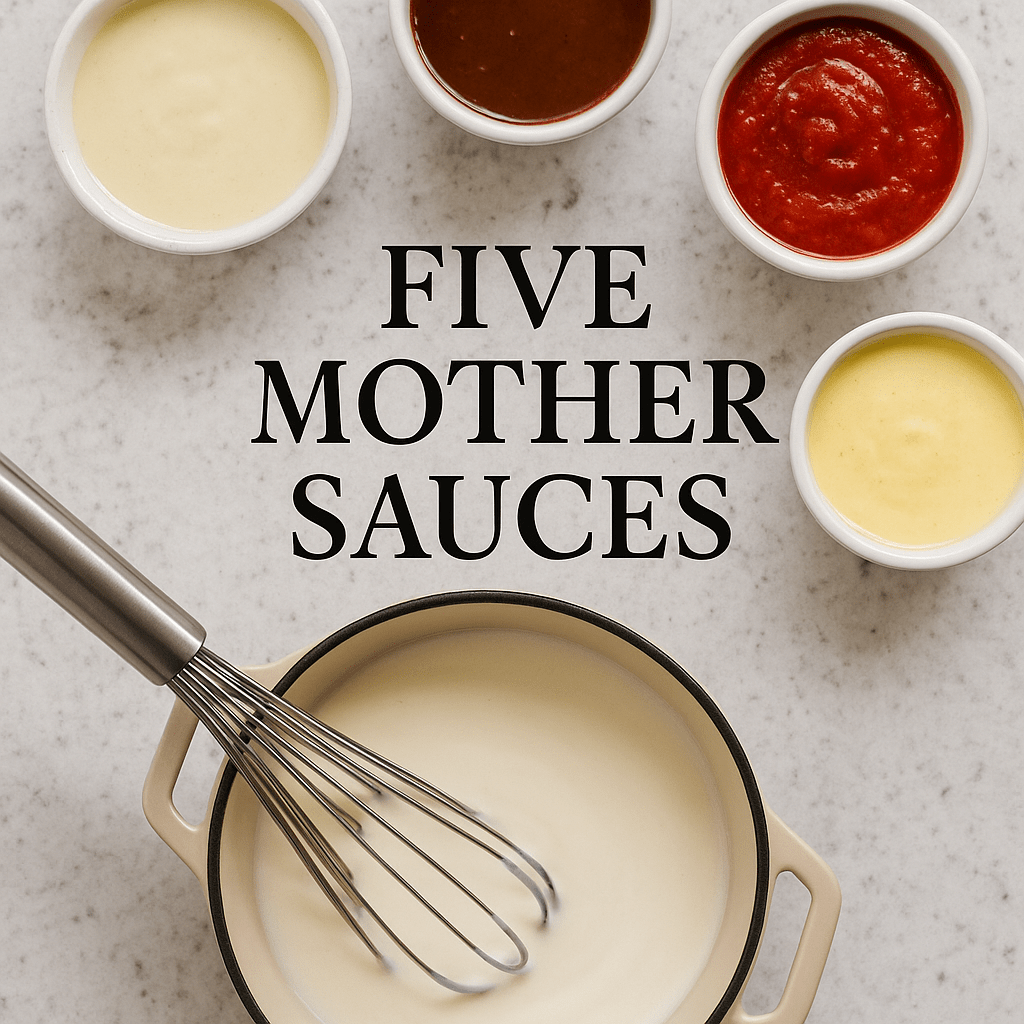
The five mother sauces — do you know them all?
If not, that’s okay! It took me a while to learn them, too. But if you do know them, stick around — you might still pick up something new!
Béchamel
Béchamel is, in my opinion, my favorite of the mother sauces — and here’s why: it’s the base for Alfredo!
To sum it up, a béchamel starts with a roux (check out my Roux post), then you add cream — heavy cream or milk both work beautifully. Whisk like your life depends on it so it doesn’t burn (because most of us have made that mistake).
Once it’s smooth and creamy, the fun begins. Add cheese? Yes, please. Salt and pepper? Absolutely. Spices? Of course! Then take it a step further — pair it with something that lets it shine. Think pasta, potatoes au gratin, soups, or even meatballs in a cream sauce. The possibilities are endless!
Béchamel is considered a mother sauce because it serves as a foundational base in French cuisine and can be transformed into countless “daughter sauces” — the next best thing to the mothers themselves.
Velouté
Velouté is similar to béchamel, but instead of cream, it’s made with a light-colored stock. I recommend using stock rather than broth, as it produces a lighter, silkier sauce.
To make a velouté, start with a blonde roux — cooked just enough to remove the raw flour taste while keeping a pale color. Add your stock gradually, whisking until smooth, then season with salt and pepper.
And what can you use it for? Oh, the options! Chicken pot pie, poultry dishes, or even vegetables — velouté adds elegance to them all.
Espagnole
Espagnole is the most common brown sauce out there. But before I tell you about the sauce, let’s talk about the pronunciation of the sauce. You prEspagnole is the most common brown sauce, and it’s as rich in history as it is in flavor.
Let’s clear up the pronunciation first — it’s said like es-pan-yol, similar to español, though this sauce is French with Spanish influence.
To make an Espagnole sauce, you’ll need:
- A mirepoix of carrots, onions, and celery (explained below), cooked in butter or beef fat until softened and browned
- A bit of flour to form a brown roux
- Tomato paste, followed by a rich brown stock (veal or beef work best)
- Herbs like thyme and bay leaves
Let it all simmer for 30–45 minutes (but no longer than 2 hours), then strain for a smooth, velvety finish.
Espagnole pairs beautifully with braised and roasted meats, gravies, soups — and it’s the base for a variety of classic French sauces.
Tomato
Tomato sauce is probably my second favorite of the five. It’s rich, hearty, and when made right, full of flavor.
To make a simple tomato sauce, all you need are tomatoes, butter, salt, a touch of olive oil, and perhaps an onion (peeled and halved) for depth. Fresh basil makes it sing.
Now, the big question — is tomato sauce the same as marinara?
Nope! Marinara is lighter and brighter, with more herbs and garlic, while tomato sauce is thicker, richer, and simmered for hours for that deep, comforting flavor.
Hollandaise
Hollandaise, I’ll admit, is my least favorite of the five — and here’s why: I’m a texture person, and this one can be tricky for me. Still, it’s an essential classic.
Most commonly used on eggs Benedict, hollandaise is made with egg yolks, clarified butter, lemon juice, and seasonings like salt, pepper, and sometimes a pinch of cayenne for garnish.
There are two main methods:
- The traditional route — whisking egg yolks and lemon juice over a double boiler, then slowly adding the melted butter (carefully, so the eggs don’t scramble).
- The modern shortcut — blending egg yolks, lemon juice, and seasonings, then streaming in hot melted butter while the blender runs to keep it silky smooth.
Whichever you choose, pour the butter in a slow, steady stream… trust me, rushing it leads to scrambled eggs (been there!).
What Is A Mirepoix?
A mirepoix is simply a mix of 2 parts onion, 1 part carrot, and 1 part celery — the foundation of countless soups, stews, and sauces.
When I say “2 parts, 1 part, 1 part,” that means the two “1 parts” together equal the larger portion. For example:
8 oz onion, 4 oz carrot, 4 oz celery. Simple, flavorful, and foundational.
Until Next Time…
Stay Saucy
Hailey 🍝
 Pasta-tively Delicious
Leave a comment